Small businesses rarely have a neat, predictable IT workload. One week the booking form stops sending leads. The next week the CRM needs cleanup, a landing page needs redesigning and somebody has to connect two systems that were never built to talk to each other.
That is the problem on-demand IT support is designed to solve: access to technical execution without hiring a separate person for every category of work.
What does on-demand IT support include?
The exact scope depends on the provider. A broad technical partner may handle software setup, account permissions, CRM maintenance, integrations, automations, website fixes, data migrations, dashboards and light custom development. Traditional managed IT providers usually focus more heavily on devices, networks, cybersecurity and employee help-desk tickets.
When the flexible model makes sense
- Your technical requests cross several disciplines.
- The workload is continuous, but not enough for multiple full-time hires.
- Projects stall because nobody owns the next action.
- You want one direct point of contact instead of coordinating freelancers.
- Your tools work individually but not as one operating system.
What should stay with a specialist?
No honest provider should pretend to cover everything. Regulated security audits, enterprise network architecture, advanced incident response and complex compliance work may require a dedicated specialist. A strong on-demand partner should identify that boundary early and help define the right handoff.
How to evaluate a provider
Look for an operating process
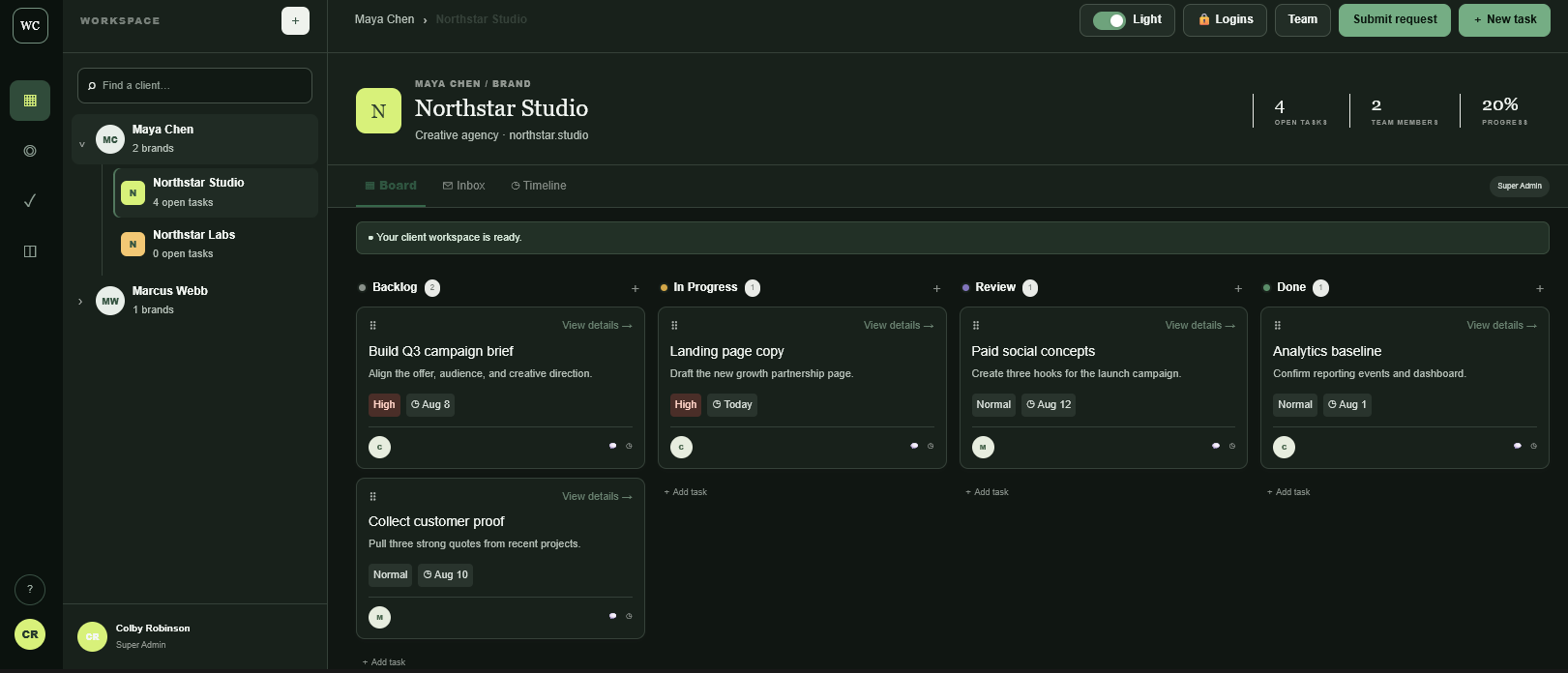
Unlimited requests are only useful when they live in an organized queue. You should be able to see what is active, what comes next and what needs your approval.
Ask who actually does the work
Direct access matters. Every handoff adds interpretation, delay and the possibility that business context gets lost.
Clarify priority and turnaround
“Unlimited” generally describes the size of the queue, not infinite simultaneous labor. The cleanest model defines how many priorities can be active at once and how urgent issues are handled.
On-demand support versus hiring
A full-time hire makes sense when one role has enough consistent, specialized work to fill a week. On-demand support is often stronger when the backlog jumps between AI, IT, design and development. You buy access to range and execution while keeping staffing flexible.
The goal is not to avoid hiring forever. It is to stop paying the coordination tax before the workload truly justifies a larger internal team.
Put your technical backlog in one queue.
The Operator gives one business unlimited task, design and development requests with one focused priority moving at a time.
Explore The Operator